The frequency feature change according to the length of cochlea differs as shown in the figure. That is, frequency goes from the base of Basilar Membrane to the end (Apex), and characteristic frequency rapidly goes down. Human’s audible frequency range is 20Hz~20000Hz, and the base of the cochlea mainly vibrates in the resonance range corresponding to labial frequency concerning external labial. When the vibration on the pure declines or is lost in concerned part, due to some trouble at some part of the base, this is indicated as hearing impairment and hearing thereshold on the labial increases. Likewise, our ears can discriminate sound, even when 100Hz differs, since the resolution of the peculiar feature frequency is high.
Therefore, the first major function is to increase vibration in the concerned frequency to supplement the Basilar Membrane’s active function, whose reaction weakens in some peculiar feature frequency. The reason why hearing-impaired people prefer digital hearing aids to analog hearing aids is because of variability in which they can flexibly cope with hearing threshold changes demonstrated differently in different frequencies. In other words, it is because an advantage that hearing aid’s frequency output features can be easily varied by making frequency output features to be the function of hearing threshold. |
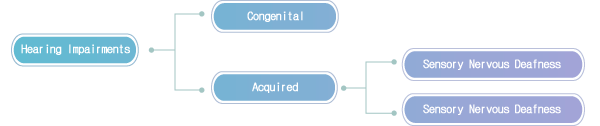
Hearing Impairments
Grade 2 - A person whose hearing loss of one ear is 90dB or higher, and
whose hearing loss of another ear is 90dB or higher.
Grade 3 - A person whose hearing loss of one ear is 80dB or higher, and
whose hearing loss of another ear is 80dB or higher.
Grade 4-1 - A person whose hearing loss of one ear is 70dB or higher, and
whose hearing loss of another ear is 70dB or higher.
Grade 4-2 - A person whose speech discrimination percentage is less than 50%
Grade 5 - A person whose hearing loss of one ear is 60dB or higher, and
whose hearing loss of another ear is 60dB or higher.
Grade 6 - A person whose hearing loss of one ear is 80dB or higher, and
whose hearing loss of another ear is 40dB or higher.
|