|
 |
 |
| |
 |
| |
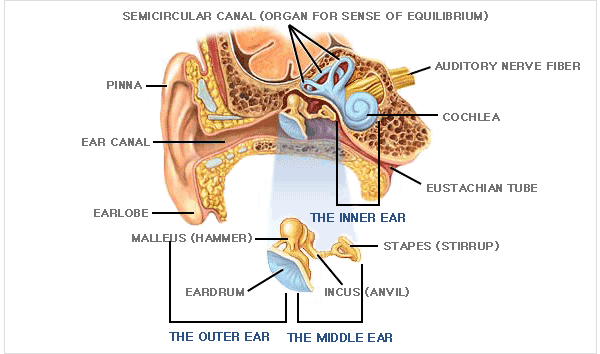
The Outer Ear consists of auricle (pinna) and ear canal, and the sound wave is delivered
to tympanic membrane (ear drum)
through auricle and ear canal.
About 6dB resonant amplification by auricle and about 10-15dB resonant amplification
is added
by ear canal between 1500-7000Hz.
Ear canal can have some different forms, but has 2.5-4KHz resonant frequency,
and the
sound pressure that passed through the ear canal vibrates the ear drum. |
| |
 |
| |
The middle ear consists of ear drum, ossicula auditus and Eustachian tube.
The ossicula auditus consists of three small
bones
- Malleus (Hammer), (Incus (Anvil)
and (Stapes (Stirrup). The vibration of ear drum concentrates mechanical energy
on the
lever movement effect of malleus and incus, and thus vibrates stapes.
The vibration of stapes is delivered to oval
window
bordering the inner ear’s cochlea,
and is converted into hydraulic energy (impedance matching effect) in the fluid
of the
inside of the cochlea. The Eustachian tube controls atmospheric pressure between middle
ear cavity and nasal
cavity. Mechanical
amplification of about 34dB is added
in the middle ear. |
| |
 |
| |
The inner ear consists of an organ for sense of equilibrium, semicircular canals
(vestibular organs) and cochlea, a hearing
organ, sharing and bordering the same fluid.
The mechanical vibration energy delivered through the oval window is
conveyed
to the end of the cochlea using the medium of inside fluid channel of the cochlea.
Thousands of hair cells are
arranged along
the cochlea fluid channel. In each hair cell,
stereocilia is arranged in a unique shape ("ㅡ", "W"),
and the vibration of the fluid
is sensed and a function of transduction triggering auditory nerve fibers is carried out.
In each hair cell, scores of auditory nerve
fibers convey hearing signal information to brain.
The hair cells lined up along the
width axis of cochlea fluid channel show peculiar frequency sensing feature along with cochlea’s basilar membrane,
and differently respond to different sound frequencies.
At the base of the cochlea,
high frequency responds, and low frequency sound pressure responds at the apex side. |
| |
 |
| |
The frequency characteristics of the ear change along the length of the cochlea differs as shown in the figure.
That is, from the base of Basilar Membrane to the end (Apex) of the BM the characteristic frequency response rapidly goes
down.Human’s audible frequency range is 20Hz~20000Hz, and the BM of the cochlea vibrates in the resonance range
corresponding to input frequency pure tone. When the vibration on the BM declines or is lost at a concerned part, due to
some trouble at some part of the cochlea, this indicates hearing impairment and hearing threshold level increases.
Likewise, our ears have sound discriminating function, even if 100Hz differs, the resolution of the characteristic frequency is
high enough to
recognize the difference.
Therefore, the first major function of hearing aid is to increase vibration in the concerned frequency position to supplement
the
Basilar Membrane’s active function, whose reaction weakens in some peculiar feature frequency.
The reason why Hearing
impaired people prefer digital hearing aids to analog hearing aids is because of variability
in which they can flexibly cope with hearing threshold changes at different frequencies.
In other words, it is because an advantage that digital hearing aid’s frequency output features can be easily modified by
inversely amplifying according to the Hearing threshold pattern. |
|
| |
|
 |
|
|
 |